
Optoelectronics and Biomedical Applications | ATMA
Optoelectronics Screen PrintingOptoelectronic printing is a process that uses high-precision screen printing technology to form conductive, insulating, or functional material patterns on substrates such as glass, films, or semiconductors. It is mainly applied in optoelectronic products such as displays, touch panels, solar cells, and sensors.★★★ Prime Application Optoelectronic Printing is mainly used for the industries as below 1.Display Industry ▲LCD / OLED display panel ▲Conductive Silver Paste Electrodes for Displays ▲Black matrix printing 2. Touch Panel ▲ITO / Silver Paste conductive circuits ▲Touch Sensors ▲FPC contact printing 3. Optical Components ▲AR / Light-shielding Patterns ▲Optical Filters 4. Functional Electronics ▲Sensor Electrodes ▲Microelectronic Circuits★★★Mass Production Challenges 1.Insufficient Stability in Fine Pattern Printing Customer Challenges: In optoelectronic panels and touch components with highly dense circuit layouts, conventional printing equipment often results in non-uniform line widths, discontinuities, or edge roughness, thereby degrading electrical conductivity performanceTechnical Solution: By adopting a precision pressure control system combined with a high‑rigidity structure and precision linear guide platform, together with high‑tension screen meshes and optimized squeegee control, the resolution of printed patterns and the stability of ink transfer can be significantly enhancedTangible Benefits: ▲Enhance fine-line printing resolution ▲Reduce line discontinuities and edge roughness ▲Improve electrical conductivity reliability2. Insufficient Uniformity in Large-Area Printing Customer Challenges: In optoelectronic glass printing, the large substrate area combined with non-uniform printing pressure often leads to film thickness variations or incomplete ink transfer, thereby impairing optical qualityTechnical Solution: By introducing a high rigidity platform and an equal pressure squeegee system, combined with precision leveling adjustment and stable ink supply control, uniform printing pressure can be ensured."Tangible Benefits: ▲Enhance layer thickness uniformity ▲Reduce incomplete ink transfer defects ▲Improve optical quality3. Difficulty in High-Precision Registration Customer Challenges: In multilayer optoelectronic printing processes, insufficient registration accuracy often leads to pattern mis-registration, resulting in structural deviations and degraded device performanceTechnical Solution: By implementing a high‑resolution CCD visual registration system with dual‑camera mark recognition, combined with a servo driven platform for automatic compensation, high precision positioning can be ensured.Tangible Benefits: ▲Enhance registration accuracy ▲Reduce pattern mis-registration ▲Improve mass production yield4.Insufficient Long-Term Production Stability Customer Challenges: During extended production line operation, insufficient equipment stability often results in quality fluctuations."Technical Solution: By employing a high‑rigidity machine body and precision transmission system, integrated with servo control, long‑term operational accuracy can be maintained.Tangible Benefits: ▲Enhance equipment stability ▲Reduce process variability ▲Increase production line utilization rate Browse ATMA screen printing equipment by category to reach the right machine type faster. Use categories to narrow by format—sheet, cylinder press or roll-to-roll—and then compare models and accessories.

Optoelectronics and Biomedical Applications
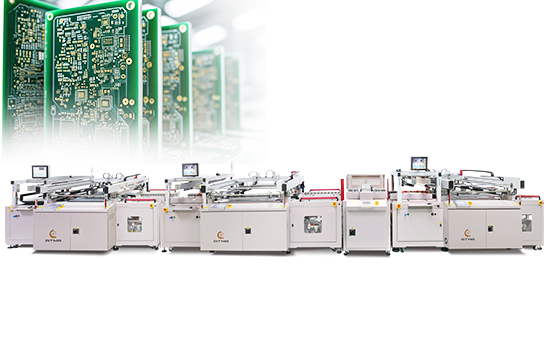
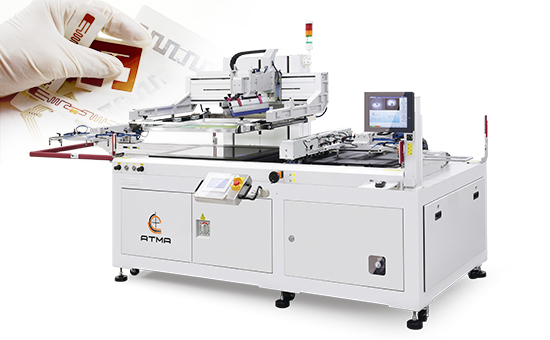
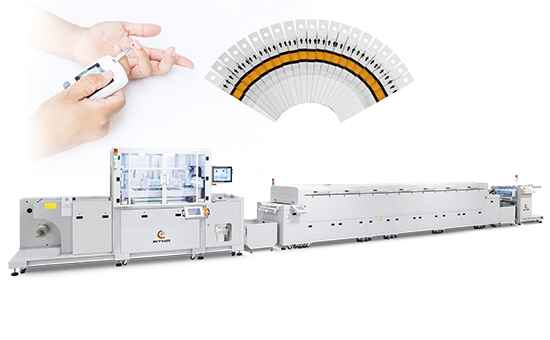
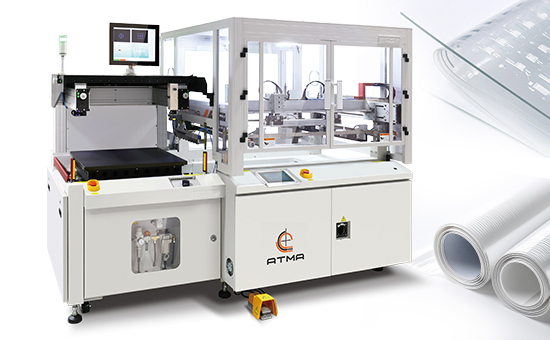
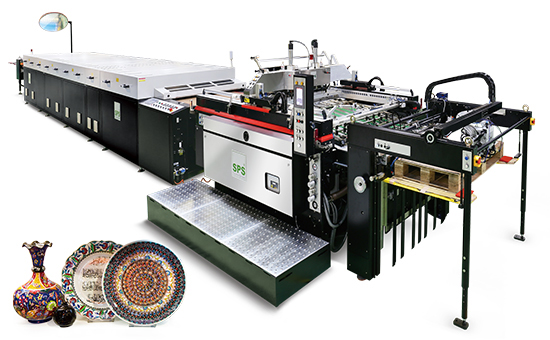
ATMA high precision screen printer is used for functional printing in optoelectronic sector
Optoelectronics Screen Printing
Optoelectronic printing is a process that uses high-precision screen printing technology to form conductive, insulating, or functional material patterns on substrates such as glass, films, or semiconductors.
It is mainly applied in optoelectronic products such as displays, touch panels, solar cells, and sensors.
★★★ Prime Application
Optoelectronic Printing is mainly used for the industries as below
1.Display Industry
▲LCD / OLED display panel
▲Conductive Silver Paste Electrodes for Displays
▲Black matrix printing
2. Touch Panel
▲ITO / Silver Paste conductive circuits
▲Touch Sensors
▲FPC contact printing
3. Optical Components
▲AR / Light-shielding Patterns
▲Optical Filters
4. Functional Electronics
▲Sensor Electrodes
▲Microelectronic Circuits
★★★Mass Production Challenges
1.Insufficient Stability in Fine Pattern Printing
Customer Challenges:
In optoelectronic panels and touch components with highly dense circuit layouts, conventional printing equipment often results in non-uniform line widths, discontinuities, or edge roughness, thereby degrading electrical conductivity performance
Technical Solution:
By adopting a precision pressure control system combined with a high‑rigidity structure and precision linear guide platform, together with high‑tension screen meshes and optimized squeegee control, the resolution of printed patterns and the stability of ink transfer can be significantly enhanced
Tangible Benefits:
▲Enhance fine-line printing resolution
▲Reduce line discontinuities and edge roughness
▲Improve electrical conductivity reliability
2. Insufficient Uniformity in Large-Area Printing
Customer Challenges:
In optoelectronic glass printing, the large substrate area combined with non-uniform printing pressure often leads to film thickness variations or incomplete ink transfer, thereby impairing optical quality
Technical Solution:
By introducing a high rigidity platform and an equal pressure squeegee system, combined with precision leveling adjustment and stable ink supply control, uniform printing pressure can be ensured."
Tangible Benefits:
▲Enhance layer thickness uniformity
▲Reduce incomplete ink transfer defects
▲Improve optical quality
3. Difficulty in High-Precision Registration
Customer Challenges:
In multilayer optoelectronic printing processes, insufficient registration accuracy often leads to pattern mis-registration, resulting in structural deviations and degraded device performance
Technical Solution:
By implementing a high‑resolution CCD visual registration system with dual‑camera mark recognition, combined with a servo driven platform for automatic compensation, high precision positioning can be ensured.
Tangible Benefits:
▲Enhance registration accuracy
▲Reduce pattern mis-registration
▲Improve mass production yield
4.Insufficient Long-Term Production Stability
Customer Challenges:
During extended production line operation, insufficient equipment stability often results in quality fluctuations."
Technical Solution:
By employing a high‑rigidity machine body and precision transmission system, integrated with servo control, long‑term operational accuracy can be maintained.
Tangible Benefits:
▲Enhance equipment stability
▲Reduce process variability
▲Increase production line utilization rate
Advanced optoelectronics screen printer with visual system is used for high precision functional printing, camera system captures substrates' target auto alignment to attain repeatability registration accuracy +/- 0.05 mm. Besides, motorized digital control calibrates automatically the squeegee leveling and depth, the equalized air pressure is applied to assure squeegee printing uniform ink layer, various features of machine which crucially affects printing ink deposit in resulting stable functionality of ink layer.
ATMA is devoted into innovative design in long term and committed with top quality, ATMA has been certified by the renowned brand world class fabricator of smart phone, tablet and notebook PC as sole supplier for screen printing machine. ATMA high precision screen printer is used by fabrication process of touch panel (resistive or capacitive type) to print dot spacer or insulation onto ITO glass (or film) as well as various optoelectronic products as stated below.




Customer Favorites
 Download
 Optoelectronics and Biomedical Applications | ATMA
Browse our screen printer catalog to compare models by printing format, automation level, and line compatibility—then narrow to the best-fit options.
Since 1979, ATMA has focused on screen printing equipment, supporting buyers in selecting a screen printer and matching accessories like feeders and air dryers.
Tell us your material and output goals—ATMA will propose a screen printer setup and a clear shortlist to move forward.


